

Being named in a First Information Report (FIR) for an offence you did not commit can be stressful. You may worry about arrest, police questioning, damage to your reputation and the possibility of a criminal case.
However, an FIR does not mean that you are guilty. It is the starting point of a criminal investigation. You have legal rights and remedies if someone deliberately makes false allegations against you.
Indian law provides ways to defend yourself, seek protection from arrest, challenge an FIR and, in appropriate cases, take legal action against the person who knowingly made a false complaint.
This article explains what happens after a false FIR, what steps you should take and how you can protect yourself under Indian law.
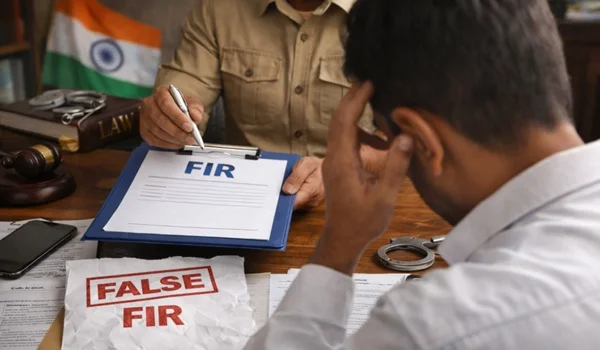
What Is a False FIR?
An FIR is a formal record of information given to the police about the commission of a cognizable offence. It is generally registered under Section 173 of the Bharatiya Nagarik Suraksha Sanhita (BNSS), 2023.
A false FIR is one that contains allegations that are knowingly fabricated or deliberately made to implicate an innocent person in a criminal offence.
For example:
- A person files a theft complaint against a neighbour because of a personal dispute, even though no theft took place.
- Someone falsely accuses a business partner of cheating to put pressure on them during a financial disagreement.
- A person makes a fabricated assault allegation to take revenge after an argument.
- Someone deliberately provides false information to the police to get another person arrested.
An allegation that cannot be proved is not automatically a false FIR. There is a difference between a complaint that is unsubstantiated, a genuine mistake and a complaint deliberately made with knowledge that the allegations are false.
This distinction is important because legal action against the complainant generally requires evidence of the relevant dishonest or wrongful intention.
What Happens After a False FIR Is Registered?
Once the police register an FIR, they may begin investigating the allegations. The exact procedure depends on the offence, the available evidence and the applicable provisions of the BNSS.
The following steps may take place.
Police Investigation Begins
The police may contact the person named in the FIR, record statements, visit the place of the alleged incident and collect relevant evidence.
They may also examine:
- CCTV footage
- Mobile phone records, where legally obtained
- WhatsApp messages and emails
- Bank transactions
- Photographs and videos
- Medical reports
- Witness statements
- Other documents connected with the allegations
The police must investigate the case according to law. They should not treat the complainant’s allegations as established facts without investigation.
You May Be Called for Questioning
The investigating officer may ask you to appear for questioning or provide information.
If you receive a lawful notice, do not ignore it. Consult a criminal lawyer and respond appropriately.
Under the BNSS, Section 35 deals with arrest by police in specified circumstances and provides safeguards relating to arrest. In cases where arrest is not required, the police may issue a notice directing the person to appear.
You May Be Arrested in Certain Cases
Registration of an FIR does not automatically mean that the accused must be arrested.
The police must follow the applicable legal requirements for arrest. The nature of the offence, available evidence, possibility of cooperation with the investigation and other statutory considerations may be relevant.
If the FIR involves a non-bailable offence and you reasonably fear arrest, you may consider applying for anticipatory bail.
The Police May File a Charge Sheet or Closure Report
After completing the investigation, the police may submit a police report to the Magistrate.
Depending on the evidence, the police may:
- File a charge sheet if they find sufficient material to proceed.
- Submit a closure or final report if the evidence does not support prosecution.
- Take other steps permitted by law where further investigation is required.
A closure report can be an important development for a person falsely accused, but it does not always automatically end the matter. The Magistrate may consider the report and the complainant’s objections before deciding what action should follow.
What Should You Do If Someone Files a False FIR Against You?
Your response during the early stages of the investigation can be important. Avoid emotional reactions and focus on preserving evidence and following the legal process.
Obtain a Copy of the FIR
First, find out whether an FIR has actually been registered against you.
Try to obtain the following information:
- FIR number
- Police station name
- Date of registration
- Sections of law mentioned
- Name of the investigating officer
- Details of the allegations
Read the FIR carefully and identify which allegations are incorrect.
A lawyer can help you understand the legal sections and possible consequences.
Contact a Criminal Lawyer
Consult a criminal lawyer as soon as possible, particularly if the FIR involves serious or non-bailable offences.
A lawyer can help you:
- Understand the allegations.
- Check whether arrest is legally possible.
- Apply for anticipatory bail where appropriate.
- Prepare a written representation to the investigating officer.
- Collect and organise evidence.
- Consider whether the FIR can be challenged before the High Court.
Do not wait until an arrest takes place if you have a genuine reason to fear one.
Preserve Evidence Supporting Your Defence
Evidence may help establish that the allegations are incorrect or that you were not involved in the alleged incident.
Depending on the case, preserve:
- CCTV recordings
- WhatsApp chats
- Emails
- Call records and relevant communication
- Bank statements
- Payment receipts
- Travel tickets
- Location-related records
- Photographs and videos
- Names and contact details of witnesses
Preserve original electronic records wherever possible. Do not edit, delete or manipulate messages, photographs or videos.
If electronic evidence is important, ask your lawyer how to preserve it properly and meet applicable evidentiary requirements.
Cooperate With the Investigation
Do not threaten the complainant, influence witnesses or attempt to destroy evidence.
If the police issue a lawful notice, respond within the specified time and keep a record of your appearance and submissions.
Cooperation does not mean that you must admit to allegations you dispute. You can exercise your legal rights while participating in the investigation.
Submit a Written Representation to the Police
If you have evidence showing that the allegations are false, you or your lawyer may submit a written representation to the investigating officer or senior police officials.
The representation should clearly explain:
- Which allegations are incorrect.
- Why the allegations are incorrect.
- What evidence supports your version.
- Whether there are witnesses who can confirm the facts.
- Whether there is any relevant background, such as a property or financial dispute.
Keep a copy of the representation and proof of submission.
Can You Get Anticipatory Bail in a False FIR?
Important legal protection
Yes. If you have reason to believe that you may be arrested for a non-bailable offence, you can apply for anticipatory bail under Section 482 of the Bharatiya Nagarik Suraksha Sanhita, 2023.
An application may be made before:
- The Court of Session
- The High Court
Anticipatory bail is a direction that provides protection against arrest if the person is arrested in connection with the specified accusation, subject to the court’s conditions.
When Should You Apply?
You may consider anticipatory bail when:
- The FIR contains serious allegations.
- The offence is non-bailable.
- The police may arrest you during the investigation.
- There is a genuine risk of arrest despite your willingness to cooperate.
- The allegations appear fabricated and you have supporting material.
The court considers several factors, including the nature and seriousness of the accusation, the applicant’s circumstances, the possibility of absconding and whether custodial interrogation is necessary.
Does Anticipatory Bail Mean the FIR Is Cancelled?
No.
Anticipatory bail protects you from arrest in the relevant case, but it does not cancel the FIR or end the investigation.
The police may continue investigating the allegations. You may also have to comply with conditions imposed by the court.
Can You Get a False FIR Quashed by the High Court?
Yes. In appropriate cases, the High Court can quash an FIR under its inherent powers.
The relevant provision is Section 528 of the Bharatiya Nagarik Suraksha Sanhita, 2023. It preserves the inherent powers of the High Court to make orders necessary to give effect to orders under the Sanhita, prevent abuse of the process of any court or otherwise secure the ends of justice.
A person accused in a false FIR may approach the High Court seeking quashing if the facts and legal grounds justify such relief.
Grounds for Quashing an FIR
The High Court may consider quashing an FIR in circumstances such as:
- The allegations, even if accepted as stated, do not disclose an offence.
- The FIR is barred by a legal provision.
- The criminal proceedings are clearly an abuse of the process of law.
- The allegations are inherently improbable in the particular circumstances.
- The case falls within recognised judicial principles for quashing criminal proceedings.
- The dispute has been settled and the nature of the offence legally permits quashing on that basis.
However, the High Court does not normally conduct a full criminal trial while deciding an FIR-quashing petition.
If the FIR discloses a cognizable offence and the allegations require investigation, the court may refuse to interfere at an early stage.
Can the High Court Quash an FIR Because It Is Based on a Personal Dispute?
Not automatically.
A personal, property or business dispute may sometimes involve criminal allegations. The court examines the actual facts and whether the ingredients of a criminal offence are disclosed.
A settlement between the parties may support a quashing request in suitable cases, but serious offences affecting society cannot necessarily be closed merely because the complainant agrees.
What Legal Action Can You Take Against the Person Who Filed a False FIR?
If you can establish that someone knowingly made a false accusation with the required wrongful intention, you may have legal remedies against that person.
The Bharatiya Nyaya Sanhita (BNS), 2023 contains provisions dealing with false information and false criminal charges.
Section 248 of the BNS: False Charge of an Offence
Section 248 deals with a person who, intending to cause injury to another person, institutes or causes a criminal proceeding to be instituted, or falsely charges someone with an offence, knowing that there is no just or lawful ground for the charge or proceeding.
The punishment may include:
- Imprisonment up to five years.
- Fine up to ₹2 lakh.
- Both imprisonment and fine.
If the false criminal proceeding concerns an offence punishable with death, life imprisonment or imprisonment for ten years or more, the punishment may extend to ten years of imprisonment along with a fine.
This provision does not apply merely because a complaint fails. The required intention and knowledge must be established.
Section 217 of the BNS: Giving False Information to a Public Servant
Section 217 deals with giving information known or believed to be false to a public servant, intending to cause or knowing it is likely to cause the public servant to use lawful powers to the injury or annoyance of another person.
The punishment may extend to one year of imprisonment, a fine up to ₹10,000, or both.
Section 240 of the BNS: Giving False Information About an Offence
Section 240 applies when a person, knowing or having reason to believe that an offence has been committed, gives information about that offence which they know or believe to be false.
The punishment may extend to two years of imprisonment, a fine, or both.
What About False Evidence?
If someone fabricates documents, electronic records or other evidence to falsely implicate you, additional provisions may apply.
For example, Section 228 of the BNS deals with fabricating false evidence. The exact offence and punishment depend on the conduct and circumstances.
Important: The applicable provision depends on what the complainant actually did. A lawyer should examine the evidence before deciding which legal action is appropriate.
Can You File a Counter-Complaint Against the Complainant?
Yes, you may submit a complaint if you have evidence that the other person committed an offence.
For example, if someone fabricated documents, threatened you, forged signatures or deliberately gave false information to the police, you may report that conduct.
You can consider the following steps:
- Prepare a written complaint explaining the facts.
- Attach supporting documents and electronic evidence.
- Submit it to the appropriate police station.
- If necessary, approach senior police officials.
- Consult a lawyer about filing a complaint before the competent Magistrate.
However, a counter-complaint should not be filed merely to retaliate. It should be based on specific facts and evidence.
What If the Police Do Not Accept Your Version?
Sometimes, an accused person may feel that the investigating officer is ignoring evidence or acting unfairly.
You can take lawful steps to bring your defence material to the attention of the authorities.
Approach Senior Police Officials
You may submit a written representation to senior officers, explaining why the investigation is unfair or incomplete.
Attach relevant evidence and request that the investigating officer consider it.
Approach the Magistrate
Depending on the stage of the proceedings and the nature of the grievance, you may approach the competent Magistrate through the procedure available under the BNSS.
A Magistrate has statutory powers relating to complaints and investigation-related matters. Your lawyer can advise which procedure applies to your circumstances.
Approach the High Court
If there is a serious abuse of process, unlawful police action or a legally sustainable ground for quashing, you may approach the High Court.
The appropriate remedy depends on the facts. A High Court petition is not a substitute for every disagreement with the police investigation.
What Happens If the Police Find That the FIR Is False?
If the investigation does not support the allegations, the police may submit a closure report or final report to the Magistrate.
The following may happen:
| Situation | Possible outcome |
| Evidence does not support the allegations | Police may submit a closure report |
| Evidence establishes an offence | Police may file a charge sheet |
| Further investigation is required | Further investigation may take place |
| Complainant objects to closure | Magistrate may consider the objection |
| Court accepts the closure report | Proceedings may come to an end, subject to applicable legal remedies |
The Magistrate is not automatically bound to accept the police’s closure report. The court may consider the material and follow the procedure prescribed by law.
A closure report is also not the same as an acquittal after trial.
Difference Between a False FIR and an Acquittal
These terms are often confused, but they have different meanings.
| Basis | False FIR | Acquittal |
| Meaning | An FIR containing knowingly false allegations | A court finds the accused not guilty after trial |
| Stage | May be identified during investigation or later proceedings | Usually after the trial |
| Decision-maker | Police may report allegations as unsupported; court decides legal consequences | Criminal court |
| Result | May lead to closure or quashing, depending on the case | Accused is acquitted |
| Action against complainant | May be possible if legal requirements are met | Acquittal alone does not automatically establish a false complaint |
An acquittal does not automatically prove that the original FIR was deliberately false. The person seeking action against the complainant must establish the ingredients of the relevant offence.
Documents and Evidence You Should Keep
If you are facing a false FIR, organise your records from the beginning.
| Document or evidence | Why it may be useful |
| Copy of FIR | Shows the allegations and legal sections |
| Identity documents | Helps establish your identity |
| WhatsApp chats and emails | May show the actual communication |
| CCTV footage | May establish what happened at the location |
| Bank statements | May help in financial or transaction disputes |
| Travel records | May support your whereabouts |
| Medical documents | May be relevant in assault-related allegations |
| Witness details | Helps identify people who know the facts |
| Police notices | Records official communication |
| Written representations | Shows that you brought relevant facts to the investigation |
Keep original records safe and maintain backups. Do not create or modify evidence to support your defence.
Common Mistakes to Avoid When Facing a False FIR
Certain actions can make the situation more difficult.
- Do not ignore police notices. Respond through the proper legal process.
- Do not threaten the complainant. This may create additional legal problems.
- Do not delete messages or call records. They may be relevant evidence.
- Do not abscond. Avoiding the investigation can weaken your position.
- Do not sign blank papers. Read documents carefully and seek legal advice.
- Do not post allegations on social media. Public statements may create further disputes.
- Do not file a revenge complaint. Any counter-case should have a genuine legal basis.
- Do not assume that anticipatory bail cancels the FIR. These are separate legal remedies.
Frequently Asked Questions (FAQs)
Can police arrest me immediately after someone files a false FIR?
Not automatically. Arrest must follow the legal requirements applicable to the offence and the circumstances. If you fear arrest in a non-bailable offence, you may consider applying for anticipatory bail under Section 482 of the BNSS.
Can I file a case against someone for filing a false FIR?
Yes, if you have evidence that the person knowingly made a false accusation with the intention required by law. Section 248 of the BNS may apply to a false criminal charge made with intent to injure.
How can I prove that an FIR is false?
You can rely on evidence such as CCTV footage, messages, emails, financial records, travel documents, witness statements and other material that contradicts the allegations. The relevant evidence depends on the nature of the case.
Can I get compensation for a false FIR?
Compensation is not automatically granted whenever an FIR is found to be false or a person is acquitted. Depending on the facts, you may explore remedies under applicable criminal, civil or other laws. A lawyer can assess whether a claim is legally maintainable.
Can a false FIR affect my job?
It may create practical difficulties, particularly where an employer conducts a background check or the job involves legal or regulatory requirements. However, an FIR is not the same as a conviction. The effect depends on the employer’s rules, the nature of the job and the stage of the criminal case.
Can I travel abroad if an FIR is registered against me?
An FIR does not automatically impose a travel ban. However, a court order, bail condition, lookout circular or other lawful restriction may affect international travel. Check your legal position before making travel plans.
Can the complainant withdraw a false FIR?
A complainant cannot simply withdraw every FIR by submitting a request to the police. The procedure depends on the offence and stage of the case. Some matters may be compounded under law, while others may require a High Court order or follow the regular criminal process.
How long does it take to quash a false FIR?
There is no fixed time limit. It depends on the High Court’s workload, the complexity of the allegations, the documents available and whether the court requires a response from the other parties.
Conclusion
A false FIR can create serious legal and personal difficulties, but registration of an FIR does not establish guilt. You have the right to defend yourself, cooperate with a lawful investigation and use appropriate legal remedies.
If you are named in a false FIR, obtain its copy, preserve relevant evidence, consult a criminal lawyer and consider anticipatory bail if arrest is a genuine concern. In suitable cases, you may approach the High Court for quashing under Section 528 of the BNSS.
You may also take action against a person who knowingly files a false criminal charge, provided the legal requirements are satisfied.
The most important thing is to act lawfully, preserve evidence and avoid taking steps that could weaken your defence.
Disclaimer: This article is for general legal information only and does not constitute legal advice. The appropriate remedy depends on the facts, applicable law and stage of the criminal proceedings. Consult a qualified criminal lawyer for advice on a specific case.