

A Bachelor of Commerce (B.Com) is one of the most popular graduation degrees in India. It provides a foundation in accounting, finance, taxation, economics, business law and management. After completing B.Com, students can explore careers in banking, accounting, financial services, taxation, insurance, marketing, government departments and corporate organisations.
However, many graduates are unsure about what to do after B.Com. Some want to start earning immediately, while others prefer professional qualifications such as Chartered Accountancy (CA), Company Secretary (CS), Cost and Management Accountancy (CMA), MBA or CFA.
The good news is that B.Com graduates have several career options, and they do not necessarily need to pursue an MBA or another degree to get a job. The right combination of practical skills, professional qualifications and work experience can help build a strong career.
This article explains the best career options after B.Com in India, including job profiles, expected salaries, professional courses and government job opportunities.
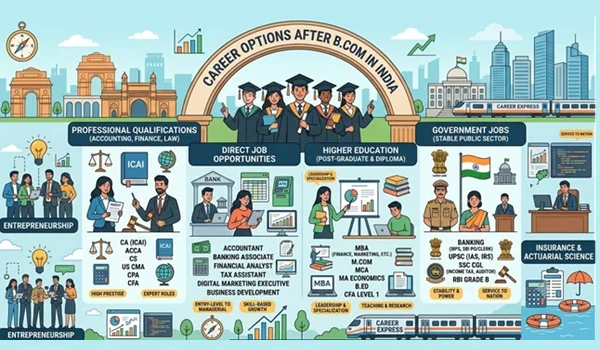
Career Options After B.Com in India: Overview
After graduation, B.Com students can choose from four major career paths:
- Private-sector jobs: Accounting, banking, taxation, finance, insurance and business operations.
- Professional courses: CA, CS, CMA, CFA and ACCA.
- Higher education: MBA, M.Com, PGDM and LLB.
- Government jobs: Banking examinations, SSC CGL, UPSC and State PSC examinations.
The following table provides an overview of popular options.
| Career option | Qualification or requirement | Approximate starting salary |
| Accountant | B.Com and accounting skills | ₹2.4–4 LPA |
| Accounts Executive | B.Com and accounting software knowledge | ₹2.5–4.5 LPA |
| Tax Assistant | B.Com and taxation knowledge | ₹2.5–4.5 LPA |
| Financial Analyst | B.Com with financial analysis skills | ₹3.5–6 LPA |
| Banking Executive | B.Com and banking knowledge | ₹2.5–4.5 LPA |
| Audit Associate | B.Com and audit knowledge | ₹2.5–5 LPA |
| HR Executive | B.Com and HR skills | ₹2.5–4.5 LPA |
| Digital Marketing Executive | Degree and digital marketing skills | ₹2.5–5 LPA |
| Chartered Accountant | CA qualification | Varies by experience and employer |
| Company Secretary | CS qualification | Varies by experience and employer |
| Cost and Management Accountant | CMA qualification | Varies by experience and employer |
| Financial Risk Analyst | Relevant finance or risk qualifications | ₹3.5–6 LPA |
Salary figures are indicative estimates for entry-level roles in India, not guaranteed salary offers. Actual pay depends on the employer, city, skills, qualifications and interview performance. Professional qualification salaries can vary considerably.
Best Private-Sector Jobs After B.Com
B.Com graduates can apply for several entry-level positions in private companies, banks, accounting firms, insurance companies and financial institutions.
Here are some popular job options.
Accountant
Accounting is one of the most common career choices after B.Com. Accountants maintain financial records, prepare reports, verify transactions and support business compliance.
Main responsibilities:
- Recording daily financial transactions.
- Preparing purchase and sales entries.
- Maintaining ledgers.
- Preparing bank reconciliation statements.
- Supporting GST and TDS compliance.
- Preparing basic financial reports.
Required skills:
- Accounting principles
- Tally Prime
- MS Excel
- GST basics
- Financial documentation
Salary: Approximately ₹2.4–4 LPA for freshers.
Candidates with knowledge of accounting software, GST returns, TDS and practical bookkeeping may find more opportunities.
Accounts Executive
Accounts Executives handle the day-to-day accounting activities of a business. They may work in manufacturing companies, service organisations, trading businesses and accounting firms.
Main responsibilities:
- Managing sales and purchase records.
- Preparing invoices.
- Handling vendor and customer accounts.
- Maintaining expense records.
- Supporting monthly financial closing.
- Assisting with tax-related documentation.
Required skills: Tally Prime, MS Excel, accounting knowledge, invoice processing and GST basics.
Salary: Approximately ₹2.5–4.5 LPA.
This is a suitable option for fresh B.Com graduates who want to start their careers in accounting and finance.
Tax Assistant or Tax Executive
Taxation is another career option for commerce graduates. Tax Assistants work with accounting firms, tax consultants, companies and financial service providers.
Their work may involve income tax returns, GST compliance, TDS calculations and tax documentation.
Main responsibilities:
- Preparing income tax-related documents.
- Assisting with GST return preparation.
- Calculating TDS.
- Maintaining tax records.
- Supporting tax audits.
- Helping clients organise financial information.
Required skills: Income tax basics, GST, TDS, accounting and Excel.
Salary: Approximately ₹2.5–4.5 LPA.
B.Com graduates can improve their employment prospects by learning practical taxation procedures and gaining experience with relevant government filing systems.
Financial Analyst
Financial Analysts study financial information to help businesses make better decisions. They may work in banks, investment companies, consulting firms and corporate finance departments.
Main responsibilities:
- Analysing financial statements.
- Preparing financial reports.
- Comparing business performance.
- Studying revenue and expenses.
- Preparing budgets and forecasts.
- Supporting investment and financial decisions.
Required skills:
- Advanced Excel
- Financial statement analysis
- Financial modelling
- Accounting knowledge
- Power BI or other data tools
Salary: Approximately ₹3.5–6 LPA for suitable entry-level positions.
Candidates with additional financial modelling, analytics or investment-related training may qualify for more specialised roles.
Banking Executive
B.Com graduates can work in private banks and financial institutions in customer service, operations, documentation and relationship management.
Main responsibilities:
- Handling customer enquiries.
- Supporting account opening.
- Processing banking documentation.
- Assisting with loan applications.
- Explaining financial products.
- Maintaining customer records.
Required skills: Communication, banking knowledge, computer skills and customer service.
Salary: Approximately ₹2.5–4.5 LPA for entry-level private-sector roles.
Graduates interested in officer-level banking positions can also prepare for IBPS PO and SBI PO examinations.
Audit Associate
Audit Associates work with CA firms, consulting companies and internal audit departments. They help verify financial records and check whether business transactions follow applicable rules and procedures.
Main responsibilities:
- Checking invoices and financial records.
- Verifying accounting entries.
- Reviewing supporting documents.
- Assisting with audit reports.
- Identifying accounting errors.
- Supporting statutory and internal audits.
Required skills: Accounting, auditing basics, Excel and financial documentation.
Salary: Approximately ₹2.5–5 LPA.
This career can provide useful practical experience for students planning to pursue CA or other finance qualifications.
Human Resource Executive
B.Com graduates can also enter the human resources field. HR Executives support recruitment, employee records, attendance, payroll and other HR activities.
Main responsibilities:
- Screening job applications.
- Coordinating interviews.
- Maintaining employee records.
- Supporting onboarding.
- Managing attendance information.
- Assisting with payroll processing.
Required skills: Communication, MS Excel, HR documentation and basic employment law knowledge.
Salary: Approximately ₹2.5–4.5 LPA.
A specialised HR qualification or MBA in Human Resource Management can help candidates move into higher-level positions.
Digital Marketing Executive
Digital marketing is a growing career option for graduates from different educational backgrounds, including commerce.
Digital Marketing Executives help companies promote products and services through online channels.
Main responsibilities:
- Managing social media accounts.
- Supporting search engine optimisation.
- Preparing marketing content.
- Running digital advertising campaigns.
- Analysing website and campaign performance.
- Generating online leads.
Required skills: SEO, social media marketing, Google Ads, content marketing and analytics.
Salary: Approximately ₹2.5–5 LPA for entry-level positions.
B.Com graduates interested in marketing can start with practical training and build a portfolio of projects.
Best Professional Courses After B.Com
Professional qualifications can help B.Com graduates specialise in accounting, taxation, corporate law, investment analysis and financial management.
The best course depends on your interests, budget, academic performance and willingness to study for professional examinations.
Chartered Accountancy (CA)
Best for: Accounting, auditing, taxation and financial advisory careers
Chartered Accountancy is one of the most recognised professional qualifications in India. It is offered by the Institute of Chartered Accountants of India (ICAI).
A CA can work in areas such as:
- Statutory auditing
- Internal auditing
- Income tax
- GST advisory
- Financial reporting
- Corporate finance
- Risk management
- Business consultancy
Eligibility and course route
Graduates can enter the CA Intermediate course through the Direct Entry Route if they meet ICAI’s prescribed eligibility conditions.
Commerce graduates generally need at least 55% marks, while graduates from other streams generally need at least 60% marks. Candidates who do not qualify for direct entry can follow the Foundation route.
The CA qualification involves examinations, prescribed practical training and other requirements under ICAI rules.
Duration: Depends on the entry route, examination attempts and completion of practical training.
Salary: Newly qualified CAs may receive a wide range of offers depending on their skills, experience, location and employer. There is no fixed starting salary.
CA is a suitable choice for students who enjoy accounting, taxation, auditing and financial regulations.
Company Secretary (CS)
Best for: Corporate law, compliance and company management
The Company Secretary course is conducted by the Institute of Company Secretaries of India (ICSI).
A Company Secretary helps companies follow corporate laws, maintain statutory records and complete regulatory compliance requirements.
Career opportunities:
- Company Secretary
- Corporate Compliance Executive
- Legal and Compliance Officer
- Corporate Governance Professional
- Secretarial Auditor, subject to applicable eligibility
Eligibility and course route
Graduates may be eligible for direct entry into the CS Executive Programme, subject to ICSI rules and applicable exemptions.
The course includes the Executive and Professional stages, along with prescribed training and other requirements.
Duration: Varies according to examination performance and training completion.
Salary: Depends on the organisation, experience and professional qualification.
CS is suitable for students interested in corporate law, business regulations and company administration.
Cost and Management Accountancy (CMA)
Best for: Cost accounting, budgeting and financial planning
The CMA qualification is offered by the Institute of Cost Accountants of India (ICMAI).
Cost and Management Accountants help organisations control costs, prepare budgets, analyse financial performance and improve business efficiency.
Career opportunities:
- Cost Accountant
- Management Accountant
- Cost Analyst
- Financial Planning Executive
- Budget Analyst
- Management Reporting Professional
Eligibility and course route
Graduates can generally register directly for the CMA Intermediate course under the applicable ICMAI eligibility rules.
The course includes Intermediate and Final examinations, along with practical training requirements.
Duration: Depends on examination performance and training completion.
Salary: Varies according to qualification, industry, job responsibilities and experience.
CMA is particularly relevant for candidates interested in manufacturing, cost management, corporate finance and business planning.
Chartered Financial Analyst (CFA)
Best for: Investment analysis, portfolio management and financial markets
The CFA programme is an international professional qualification offered by the CFA Institute.
It focuses on investment analysis, financial reporting, equity valuation, portfolio management, ethics and financial markets.
Career opportunities:
- Investment Analyst
- Equity Research Analyst
- Portfolio Analyst
- Financial Research Associate
- Risk Analyst
- Investment Management Professional
Eligibility
Candidates generally need a bachelor’s degree or must satisfy the CFA Institute’s alternative entry requirements. The programme has three examination levels, along with work experience and membership requirements for the charter.
Duration: Varies depending on examination attempts and experience requirements.
Salary: Depends heavily on the employer, role, relevant experience and market conditions.
CFA is suitable for graduates who want to build careers in investment research, asset management and financial analysis.
Association of Chartered Certified Accountants (ACCA)
Best for: International accounting and financial reporting
ACCA is an international accounting qualification that can help graduates pursue opportunities in multinational companies, accounting firms and global finance teams.
Career opportunities:
- Financial Accountant
- Audit Associate
- Financial Reporting Analyst
- Management Accountant
- Finance Executive
Eligibility
Graduates may receive exemptions depending on their degree and subjects. The number of exemptions must be confirmed through ACCA’s official assessment.
The qualification involves examinations, an ethics module and practical experience requirements.
Duration: Depends on exemptions, examination progress and experience.
Salary: Varies by employer, location, experience and role.
ACCA can be useful for candidates interested in international accounting standards and global finance operations.
MBA in Finance
Best for: Corporate finance, banking and management roles
An MBA in Finance is a postgraduate management qualification that develops knowledge of financial management, investment decisions, banking, corporate strategy and business operations.
Career opportunities:
- Finance Manager
- Financial Analyst
- Banking Manager
- Credit Analyst
- Corporate Finance Associate
- Investment Banking Analyst
Eligibility
A recognised bachelor’s degree is generally required. Admission may be based on entrance examinations such as CAT, XAT, CMAT, MAT or institute-specific tests.
Duration: Usually two years for a full-time MBA programme.
Salary: Depends significantly on the business school, specialisation, placement opportunities and candidate profile.
An MBA from a well-regarded institution with strong industry connections can improve career opportunities. However, candidates should compare course fees, placement records and the total cost before enrolling.
Master of Commerce (M.Com)
Best for: Advanced commerce studies, teaching and research
M.Com is a postgraduate degree that provides deeper knowledge of accounting, finance, taxation, economics and business management.
Career opportunities:
- Accountant
- Finance Executive
- Research Assistant
- Taxation Professional
- Lecturer, subject to eligibility requirements
- Academic Researcher
Eligibility: A recognised bachelor’s degree, generally in commerce or a related discipline. Specific university admission conditions may differ.
Duration: Usually two years.
Salary: Depends on the job profile and additional qualifications.
Students interested in college-level teaching may consider M.Com followed by UGC NET, subject to the applicable eligibility rules.
Bachelor of Laws (LLB)
Best for: Corporate law, taxation law and legal practice
B.Com graduates can pursue a three-year LLB programme after graduation.
Commerce knowledge can be useful in areas such as corporate law, financial regulations, taxation, banking law and commercial disputes.
Career opportunities:
- Legal Associate
- Corporate Legal Executive
- Tax Law Professional
- Legal Consultant
- Advocate, after meeting the applicable enrolment and practice requirements
Eligibility: Graduation with the marks and other conditions prescribed by the university or entrance examination.
Duration: Generally three years after graduation.
This option is suitable for candidates who are interested in law and legal practice rather than a traditional accounting career.
Short-Term Courses After B.Com for Better Job Opportunities
Not every graduate wants to spend several years completing a professional qualification. Short-term courses can help develop practical skills for entry-level employment.
| Course or skill | What you learn | Possible job roles |
| Advanced Excel | Formulas, PivotTables, data analysis | MIS Executive, Accounts Executive |
| Tally Prime | Accounting entries and bookkeeping | Accountant, Accounts Assistant |
| GST and Taxation | GST returns, TDS and tax basics | Tax Assistant, GST Executive |
| Financial Modelling | Forecasting and financial analysis | Financial Analyst Trainee |
| Power BI | Data visualisation and dashboards | MIS Analyst, Reporting Analyst |
| SAP FICO | Financial accounting and controlling | SAP Support Executive |
| Digital Marketing | SEO, advertising and social media | Digital Marketing Executive |
| Business Analytics | Excel, SQL and data interpretation | Business Analyst Trainee |
| Payroll Management | Salary processing and compliance | Payroll Executive |
Important: A short-term certificate does not automatically qualify someone for a specialist position. Practical projects, software knowledge and relevant experience are also important.
Government Jobs After B.Com in India
B.Com graduates can apply for several government jobs through central and state-level recruitment examinations.
Some popular options include:
| Government job | Recruitment examination or organisation | Main eligibility |
| Bank Probationary Officer | IBPS PO, SBI PO | Graduation in any discipline |
| Bank Clerk | IBPS Customer Service Associate, SBI Clerk | Graduation, subject to notification |
| RBI Grade B Officer | Reserve Bank of India | Graduation with prescribed marks |
| RBI Assistant | Reserve Bank of India | Graduation and other conditions |
| Income Tax Inspector | SSC CGL | Graduation |
| Auditor | SSC CGL and other recruitment | Graduation, as specified |
| Assistant Section Officer | SSC CGL | Graduation |
| Civil Services Officer | UPSC CSE | Graduation |
| State Government Officer | State PSC | Graduation, subject to post requirements |
Banking Jobs
B.Com graduates can prepare for IBPS PO, SBI PO, IBPS Customer Service Associate and SBI Junior Associate recruitment.
Banking jobs may involve customer service, account management, financial transactions, loan processing and branch operations.
SSC CGL Jobs
The Staff Selection Commission Combined Graduate Level examination provides opportunities in various central government departments.
B.Com graduates can apply for eligible posts such as Income Tax Inspector, Assistant Section Officer, Auditor and Accountant.
Some statistical or specialist posts have additional educational requirements.
RBI Jobs
The Reserve Bank of India recruits candidates for officer and assistant-level positions through separate recruitment examinations.
RBI Grade B is a popular option for graduates interested in financial regulation, economics and banking. However, candidates must satisfy the prescribed marks, age and other eligibility requirements.
UPSC and State PSC
B.Com graduates can also prepare for UPSC Civil Services and State Public Service Commission examinations.
These examinations can lead to administrative, revenue, police and other government services.
Government job eligibility and salary depend on the specific post and recruitment notification. Candidates should check the latest examination rules before applying.
Best Career Options After B.Com Based on Your Interest
Choosing a course or job becomes easier when you understand which subjects and activities interest you.
| Your interest | Recommended career path |
| Accounting and taxation | CA, Accountant, Tax Consultant |
| Corporate law and compliance | CS, LLB |
| Cost control and budgeting | CMA, Cost Analyst |
| Stock market and investment | CFA, Investment Analyst |
| Banking and finance | Bank PO, MBA Finance |
| Business management | MBA, Management Trainee |
| Teaching and research | M.Com, UGC NET |
| Data and reporting | Power BI, Business Analytics |
| Marketing and advertising | Digital Marketing |
| Government employment | SSC CGL, UPSC, Banking Exams |
Do not select a course only because it is popular. Consider your interest, learning ability, financial situation and the type of work you want to do.
Skills B.Com Graduates Should Develop
A B.Com degree provides theoretical knowledge, but employers also look for practical skills.
Developing the following abilities can improve your job prospects.
Accounting and Taxation Skills
Learn bookkeeping, financial statements, GST, TDS and basic income tax procedures.
Advanced Excel
Practise formulas, PivotTables, lookup functions, data cleaning and reporting.
Accounting Software
Gain practical knowledge of Tally Prime or other accounting software used by employers.
Communication Skills
Improve professional writing, email communication, presentation and interview skills.
Financial Analysis
Learn to read balance sheets, profit and loss statements and cash flow statements.
Data Analysis
Basic knowledge of Power BI and SQL can help candidates move towards reporting and business analytics roles.
Practical Experience
Internships, live projects and entry-level jobs can help convert academic knowledge into workplace skills.
How to Choose the Right Course After B.Com
Before enrolling in a professional course or postgraduate programme, consider the following factors.
- Career goal: Decide whether you want to work in accounting, taxation, investment, banking, management or law.
- Course duration: Compare the time required to complete the qualification.
- Course fees: Consider tuition fees, examination fees, training costs and other expenses.
- Recognition: Check whether the qualification is offered by a recognised professional body or institution.
- Job opportunities: Research the roles available after completing the course.
- Practical training: Prefer programmes that provide relevant projects, internships or practical exposure.
- Personal interest: Choose a field that matches your strengths and long-term interests.
For example, CA is suitable for students interested in auditing and taxation, while CS is more relevant to corporate law and compliance. Students interested in investments may consider CFA, whereas those looking for management roles may explore an MBA.
Frequently Asked Questions (FAQs)
Which is the best career option after B.Com in India?
CA, CS, CMA, MBA Finance, banking, accounting, financial analysis and government jobs are popular options. The best choice depends on your interests, skills and career goals.
Can I get a job immediately after B.Com?
Yes. Graduates can apply for entry-level jobs such as Accountant, Accounts Executive, Tax Assistant, Audit Associate, Banking Executive and HR Executive. Practical knowledge of Excel, Tally, GST and accounting can improve employability.
Which course is best after B.Com for a high salary?
CA, CFA, MBA Finance and CMA can lead to specialised and well-paying careers. However, salary depends on professional performance, experience, employer and educational institution. No course guarantees a particular salary.
Can B.Com graduates pursue CA directly?
Yes. Eligible commerce graduates with at least 55% marks can generally enter CA Intermediate through the Direct Entry Route under ICAI rules. Graduates from other streams generally need at least 60% marks. Candidates must satisfy the applicable registration and training requirements.
Is MBA better than M.Com after B.Com?
An MBA is generally more suitable for management, business and corporate leadership careers. M.Com is more suitable for advanced commerce studies, research and academic pathways. The better option depends on your career objective and the quality and cost of the institution.
Can I get a government job after B.Com?
Yes. B.Com graduates can apply for eligible banking, SSC CGL, UPSC, RBI and State PSC examinations. Each examination has its own educational, age and other eligibility requirements.
Which short-term course is useful after B.Com?
Advanced Excel, Tally Prime, GST and taxation, Power BI, SAP FICO and financial modelling are useful options. Choose a course according to the job you want.
Can I pursue LLB after B.Com?
Yes. B.Com graduates can generally apply for a three-year LLB programme after completing graduation, subject to university admission requirements.
Is B.Com enough to become a financial analyst?
A B.Com degree can provide the foundation for entry-level financial analysis roles. However, candidates may need additional skills in Excel, financial modelling, accounting and data analysis to compete for suitable positions.
Conclusion
B.Com offers several career opportunities in India across accounting, taxation, banking, finance, insurance, management and government services. Graduates can start working immediately or pursue professional qualifications such as CA, CS, CMA, CFA and ACCA.
The right career path depends on whether you want an immediate job, a professional qualification, higher education or a government position.
If you want to start earning quickly, consider entry-level accounting, taxation or banking operations roles while developing practical skills. If you want to specialise, choose a recognised professional course that matches your interests.
Instead of pursuing multiple courses without a clear plan, select one primary career direction and build the skills and experience required to succeed in that field.