
The reduction of GST to 0 percent on individual health insurance premiums from 22 September 2025 has reshaped one of the most important financial decisions for Indian families: how much they should expect to pay for a mediclaim policy. For many buyers, the first instinct is simple — if the tax has been cut to zero, the assumption is that a Health insurance Policy should become automatically cheaper. Yet the reality is more layered, and the amount you finally pay depends on how insurers revise their base premiums, how input credit works in an exempt regime, and how the ecosystem adjusts to this regulatory change.
How GST now applies to your health premium
A mediclaim policy is categorised as a financial service under GST. Until September 2025, premiums were taxed at 18 percent. With the new exemption, GST is now 0 percent for all individual and family floater Health insurance Policy contracts. The exemption also applies to add-ons bundled within a single retail product, such as maternity benefits, personal accident cover, or wellness riders, provided they fall within the structure of the same policy.
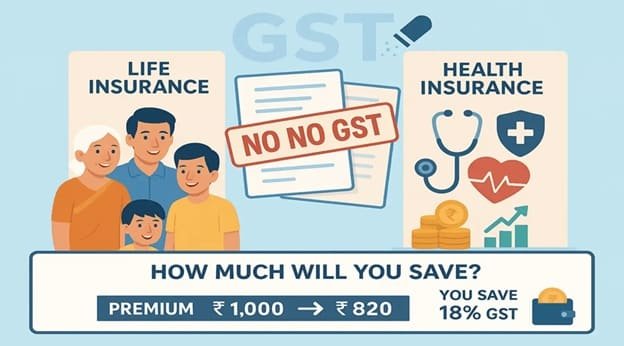
Your invoice will still show a breakup of base premium, GST line, and total payable, but the GST line will now read 0 percent. This makes the bill simpler, but it does not necessarily confirm that your mediclaim policy has become exactly 18 percent cheaper. The reason lies in how GST exemptions affect insurers.
When a service becomes exempt rather than nil-rated, insurers cannot claim input tax credit on GST they pay on procurement, technology, hospital-network services, and third-party vendor costs. When input credits are blocked, some insurers revise the base premium to account for inflation and cost pressures. So, while the GST line itself drops to zero, the base premium, which you ultimately pay, may or may not fall in the same proportion.
It is also important to understand that GST never applied to claim payouts. A Health insurance Policy claim is not a supply of service, so reimbursements and cashless settlements remain outside the GST system.
What has changed in the GST ecosystem and why it matters
The only direct GST change is the shift from an 18 percent rate to a 0 percent exemption for individual health covers from 22 September 2025. Group policies, including employer-sponsored covers, continue to attract 18 percent GST. The applicable rate depends on the date of payment. So, even for renewals, instalments or mid-term adjustments, the date you actually pay decides whether the 0 percent rule applies.
Beyond this headline rate change, several ecosystem developments shape insurer pricing:
Hospitals and input costs
Hospitals continue to have GST applied at varying rates on specific services. Non-ICU room rent above certain thresholds, for instance, attracts 5 percent GST without input credit. These cost structures influence how hospitals set tariffs, and insurers indirectly absorb some of these costs when settling claims.
Insurer input credit restrictions
Under the exemption model, insurers lose access to input tax credits. This can influence the base premium of your mediclaim policy, particularly for digitally intensive Health insurance Policy providers with high technology or service procurement costs.
Compliance and operational updates
Revisions in input service distributor rules, online service clarifications, and compliance timelines do not alter the GST rate applied to your Health insurance Policy. However, they affect the operational efficiency of insurers, which can trickle down into the annual pricing assumptions underpinning premiums.
Will the 0 percent GST rule make your premium cheaper
The short answer: yes, but not always by 18 percent.
The absence of GST removes the direct 18 percent tax, but the net impact on your mediclaim policy depends on several moving parts:
Scenario 1: Base premium unchanged
If last year your base premium was Rs. 20,000, your earlier payable was Rs. 23,600 with 18 percent GST.
If the insurer keeps the base at Rs. 20,000 in 2025–26, you now pay exactly Rs. 20,000.
This feels like a full 18 percent drop. Some insurers may adopt this approach if their input costs are stable.
Scenario 2: Base premium revised due to costs
Suppose the insurer adjusts the base to Rs. 20,600 to compensate for blocked input credits or rising medical inflation.
Your payable amount becomes Rs. 20,600 which is a saving compared with Rs. 23,600, but not a full 18 percent.
Most insurers are expected to fall into this category, creating partial but meaningful relief for Health insurance Policy buyers.
Scenario 3: Timing of renewal
If your premium was due earlier but paid on or after 22 September 2025, the 0 percent GST rule applies.
If you paid before the date, the old rate applied to that specific instalment.
The GST regime always follows the payment date, not the due date.
How the impact differs across customer groups
While the GST shift applies uniformly to individual covers, its practical effect varies for different segments.
Senior citizens
Senior citizen premiums are already high due to risk factors. Even a partial reduction in effective outgo can be substantial in rupee terms. A mediclaim policy for seniors becomes slightly easier to fund, though base premiums may still rise due to high claim frequencies.
Family floater buyers
For large covers such as Rs. 50 lakh or Rs. 1 crore, the GST amount used to be sizeable. Although the GST line now shows zero, floaters often experience frequent repricing due to rising medical inflation. Optimising structure — base plus super top-up — can be a more effective strategy than waiting for tax-based relief.
Young professionals
For millennials and Gen Z, starting early still yields the biggest savings. A Health insurance Policy bought at 25 costs dramatically less than one bought at 40. GST savings are a bonus, but the real benefit is long-term base premium stability.
MSME owners
Employer-sponsored group covers are not exempt — they still attract 18 percent GST. However, offering such covers helps employers negotiate better actuarial pricing and higher-value base premiums, which can offset some tax cost.
Rural and semi-urban households
Government schemes like PM-JAY provide limited but essential protection. A basic mediclaim policy remains valuable as a private sector supplement, especially for hospital access in Tier II and Tier III towns.
Conclusion
The new rule reducing GST to 0 percent for individual health insurance is a welcome structural change, but it does not automatically guarantee an 18 percent price drop on your mediclaim policy. The base premium, shaped by inflation, underwriting experience, and input credit rules, continues to determine how much you actually pay. By staying informed, comparing products regularly, using tax benefits, and right-sizing your cover, you can meaningfully optimise the total cost of your Health insurance Policy in the 2025-26 landscape. As the ecosystem evolves, monitoring official notifications and working with a trusted adviser will help you secure the most value from your mediclaim policy and ensure sustained protection for your family.

Shashi Kant is the Founder and Editor of BusinessScroller.com, a leading platform for business insights, finance trends, and industry analysis. With a passion for journalism and expertise in business reporting, he curates well-researched content on market strategies, startups, and corporate success stories. His vision is to provide valuable information that empowers entrepreneurs and professionals. Under his leadership, BusinessScroller.com has grown into a trusted source for in-depth articles, customer care guides, and financial expertise.