
Many borrowers believe that loan settlement and loan closure mean the same thing. However, in the banking and financial world, these two terms are completely different and can have a significant impact on your financial future.
When facing financial difficulties, some borrowers choose to settle a loan by negotiating with the lender and paying only a portion of the outstanding amount. Others repay the entire loan as per the agreement and close the account properly. While both options end the loan account, their impact on your credit score, future loan eligibility, and financial reputation can be very different.
Understanding the difference between loan settlement and loan closure is essential before making any repayment decision. This guide explains both concepts in simple English and helps you choose the right option for your situation.
What is Loan Closure?
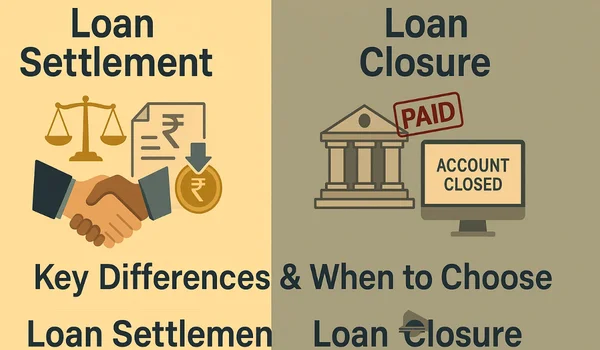
Loan closure means repaying the entire outstanding loan amount according to the agreed loan terms.
The borrower pays:
- Outstanding principal
- Applicable interest
- Any valid charges
After successful repayment, the lender marks the loan account as closed.
Example
Suppose:
| Loan Details | Amount |
| Outstanding Loan Balance | ₹2,00,000 |
| Interest and Charges | Applicable |
If the borrower pays the full amount, the loan is officially closed.
What is Loan Settlement?
Loan settlement occurs when a borrower is unable to repay the full outstanding amount and negotiates with the lender to pay a reduced amount.
The lender may agree to accept a lower amount as a one-time settlement.
Example
| Loan Details | Amount |
| Outstanding Loan | ₹2,00,000 |
| Settlement Amount | ₹1,20,000 |
The remaining balance may be waived by the lender as part of the settlement agreement.
Why Do Loan Settlements Happen?
Loan settlements usually occur when borrowers face serious financial difficulties such as:
- Job loss
- Business failure
- Medical emergencies
- Financial hardship
- Prolonged payment defaults
Settlement is generally considered a last-resort option.
Loan Settlement vs Loan Closure: Quick Comparison
| Feature | Loan Closure | Loan Settlement |
| Full Repayment | Yes | No |
| Outstanding Dues Cleared Completely | Yes | Partially |
| Credit Score Impact | Positive | Negative |
| Future Loan Eligibility | Better | May Be Difficult |
| Lender Recovery | Full | Partial |
| Credit Report Status | Closed | Settled |
| Financial Reputation | Strong | Weaker |
Eligibility for Loan Closure
Most borrowers can close a loan by paying:
- Full outstanding principal
- Applicable interest
- Valid foreclosure charges (if any)
Applicable To
- Personal Loans
- Home Loans
- Car Loans
- Business Loans
- Gold Loans
Eligibility for Loan Settlement
Settlement is generally considered when:
| Condition | Requirement |
| Financial Hardship | Usually Required |
| Payment Default | Common |
| Inability to Repay | Demonstrated |
| Lender Approval | Mandatory |
Settlement is not guaranteed and depends on lender discretion.
Benefits and Drawbacks of Loan Closure
Benefits
| Benefits | Explanation |
| Positive Credit History | Improves credit profile |
| Better Loan Eligibility | Easier future borrowing |
| No Outstanding Liability | Complete debt freedom |
| Strong Financial Reputation | Demonstrates repayment discipline |
| Better Credit Score Impact | Positive effect |
Drawbacks
| Drawbacks | Explanation |
| Requires Full Payment | Large amount may be needed |
| Foreclosure Charges | May apply in some loans |
| Reduced Liquidity | Savings may be used |
Benefits and Drawbacks of Loan Settlement
Benefits
| Benefits | Explanation |
| Reduces Immediate Burden | Lower payment required |
| Helps During Financial Crisis | Relief for distressed borrowers |
| Stops Collection Activity | May resolve overdue accounts |
| Avoids Legal Escalation | In some cases |
Drawbacks
| Drawbacks | Explanation |
| Negative Credit Report Entry | Loan marked as settled |
| Credit Score Damage | Significant impact possible |
| Future Loan Difficulty | Approval may become harder |
| Lower Lender Confidence | Seen as incomplete repayment |
| Long-Term Financial Consequences | Can remain visible for years |
Impact on Credit Score
One of the biggest differences lies in the credit report.
Loan Closure
| Impact Area | Result |
| Credit Score | Positive |
| Loan History | Good |
| Future Borrowing | Easier |
Loan Settlement
| Impact Area | Result |
| Credit Score | Negative |
| Credit Report Status | Settled |
| Future Borrowing | More Difficult |
Lenders generally prefer borrowers who close loans properly rather than settle them.
Interest Rates and Charges
Loan Closure
Possible charges may include:
| Charge Type | Applicable |
| Foreclosure Charges | Sometimes |
| GST | Applicable |
| Outstanding Interest | Payable |
Loan Settlement
Possible charges may vary depending on the agreement with the lender.
Settlement terms are negotiated individually.
Documents Required for Loan Closure
Common Documents
- Loan Account Number
- PAN Card
- Aadhaar Card
- Closure Request Form
- Identity Proof
Documents Required for Loan Settlement
Common Documents
- Loan Account Information
- Financial Hardship Proof
- Income Documents
- Settlement Request Letter
- Identity Proof
Additional documents may be requested by the lender.
Step-by-Step Loan Closure Process
Step 1
Request a loan closure statement.
Step 2
Verify outstanding dues.
Step 3
Pay the full amount.
Step 4
Obtain:
- Loan Closure Certificate
- No Dues Certificate
Step 5
Verify credit report updates.
Step-by-Step Loan Settlement Process
Step 1
Contact the lender.
Step 2
Explain financial difficulties.
Step 3
Negotiate settlement terms.
Step 4
Receive written settlement offer.
Step 5
Pay agreed settlement amount.
Step 6
Obtain settlement confirmation letter.
Loan Closure vs Loan Settlement: Detailed Comparison
| Factor | Loan Closure | Loan Settlement |
| Repayment Amount | Full Outstanding Amount | Reduced Amount |
| Credit Report Status | Closed | Settled |
| Credit Score Impact | Positive | Negative |
| Future Loan Approval | Easier | More Difficult |
| Financial Reputation | Strong | Weaker |
| Debt Obligation | Fully Cleared | Partially Waived |
| Long-Term Impact | Positive | Negative |
When Should You Choose Loan Closure?
Loan closure is usually the better option if:
- You can afford full repayment.
- You want to maintain a good credit score.
- You plan to apply for future loans.
- You want a strong financial profile.
When Should Loan Settlement Be Considered?
Settlement may be considered only if:
- Severe financial hardship exists.
- Full repayment is impossible.
- Default risk is high.
- Other repayment options have been exhausted.
It should generally be treated as a last resort.
Expert Tips Before Deciding
Prioritize Loan Closure
If financially possible, always aim for complete repayment.
Understand Credit Report Impact
Many borrowers underestimate the long-term consequences of settlement.
Get Everything in Writing
Whether closing or settling, obtain official documents from the lender.
Check Credit Reports Later
Ensure the lender updates your account correctly.
Explore Restructuring Options First
Before settling, ask about:
- EMI reduction
- Loan restructuring
- Tenure extension
Common Mistakes to Avoid
- Assuming settlement and closure are identical
- Ignoring credit score consequences
- Accepting verbal settlement agreements
- Not collecting closure certificates
- Failing to check credit report updates
- Settling loans unnecessarily
- Overlooking alternative repayment solutions
Related Keywords
You can naturally target related search terms such as:
- Loan settlement vs loan closure
- Loan settled meaning
- Loan closure process India
- Impact of loan settlement on credit score
- Personal loan settlement consequences
- Loan closure certificate
- Settled status in credit report
- Credit score after loan settlement
Conclusion
Although both loan settlement and loan closure bring an end to a loan account, they are very different from a financial and credit perspective. Loan closure means repaying the entire outstanding amount and maintaining a healthy credit profile, while loan settlement involves paying a reduced amount due to financial hardship and can negatively affect future borrowing opportunities.
Whenever possible, borrowers should prioritize complete loan closure because it strengthens creditworthiness and improves future loan eligibility. Loan settlement should generally be considered only in genuine financial emergencies when full repayment is no longer feasible.
Before making any decision, carefully evaluate the long-term impact on your credit score, financial reputation, and future access to credit.
Frequently Asked Questions (FAQs)
Q: Is loan settlement the same as loan closure?
A: No. Loan closure involves full repayment, while loan settlement involves paying a reduced negotiated amount.
Q: Which is better: loan settlement or loan closure?
A: Loan closure is generally better because it has a positive impact on your credit profile.
Q: Does loan settlement affect CIBIL score?
A: Yes. A settled status can negatively affect your credit score and future borrowing ability.
Q: Can I get a loan after settlement?
A: It may be possible, but lenders may view settled accounts as a risk factor.
Q: What documents should I collect after loan closure?
A: You should obtain a Loan Closure Certificate and No Dues Certificate.
Q: Is settlement a legal process?
A: Yes. It is a negotiated agreement between the borrower and lender, documented in writing.
Q: Can a settled loan be converted to closed status later?
A: In some situations, borrowers may discuss repayment of the remaining amount with the lender, but policies vary.
Q: How long does a settled status remain on a credit report?
A: Credit report records can remain visible for several years, depending on applicable reporting practices and bureau policies.