
If you’ve ever looked at a bond and seen a label like “AAA bonds” or “AA+” next to it, you’ve encountered a credit rating. These letter grades look simple, but they carry a lot of information about how likely an issuer is to pay back what they owe, and understanding them properly can save you from some expensive surprises.
What Is a Bond Credit Rating?
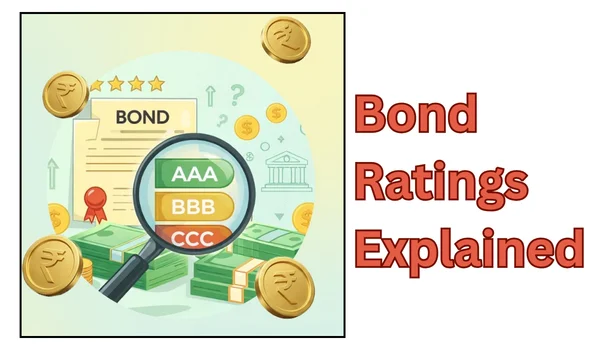
A credit rating is an independent assessment of an issuer’s ability and willingness to meet its debt obligations, both interest payments and principal repayment on time. It is not a comment on the bond’s price, nor a guarantee of anything. It’s simply a professional opinion, expressed as a letter grade, on default risk.
In India, these ratings are assigned by SEBI-registered credit rating agencies, the main ones being:
- CRISIL (a subsidiary of S&P Global)
- ICRA (affiliated with Moody’s)
- CARE Ratings
- India Ratings and Research (a Fitch Group company)
- Brickwork Ratings
Each agency uses a broadly similar scale, though the exact naming conventions differ slightly.
Decoding the Rating Scale
Ratings run from the highest safety to the highest risk. Here’s the typical structure used for long-term instruments in India:
| Rating | What It Broadly Signals |
| AAA Bonds | Highest safety; lowest credit risk |
| AA+ / AA / AA- | High safety; very low credit risk |
| A+ / A / A- | Adequate safety; low credit risk |
| BBB+ / BBB / BBB- | Moderate safety; moderate credit risk (lowest “investment grade”) |
| BB and below | Speculative; substantial credit risk (“junk” or high-yield territory) |
| C / D | Very high risk of default, or already in default |
The “+” and “-” modifiers are notches within a category — AA+ is a shade stronger than AA, which is a shade stronger than AA-. Ratings agencies also attach an outlook (Stable, Positive, Negative, or Under Watch) that signals which direction the rating might move next.
Investment Grade vs. Sub-Investment Grade
The line drawn at BBB- (or equivalent) matters a lot in practice. Anything BBB- and above is considered “investment grade,” generally viewed as having reasonable capacity to service debt. Anything below that is “sub-investment grade,” where the risk of missed payments or default rises meaningfully. Many institutional investors and mandates are restricted from holding anything below investment grade, which affects demand and liquidity for those bonds.
Why Ratings Affect Yield
Ratings and yield move in opposite directions. A AAA-rated bond, being the safest, can raise money at the lowest interest cost; investors accept a lower coupon because the risk is low. A BBB or lower-rated bond has to offer a higher coupon to compensate investors for taking on more risk. This is often called the credit spread: the extra yield a lower-rated bond pays over a comparable government or AAA-rated security.
As a rule of thumb: if a bond is offering a yield that looks unusually high compared to similarly rated peers, it’s worth asking why often the rating, sector risk, or issuer-specific concerns explain the gap.
What a Rating Does NOT Tell You
This is where many investors get tripped up. A credit rating does not tell you:
- Interest rate risk — how much the bond’s market price will move if interest rates change. Even a AAA bond can fall in price if rates rise.
- Liquidity risk — how easily you can sell the bond before maturity without a steep discount.
- Guaranteed safety — ratings are opinions based on available information at a point in time, not guarantees. Downgrades happen, and in rare cases, even highly rated issuers have defaulted.
- Tax treatment or product suitability — that depends on your own financial situation.
How to Actually Use a Rating
- Check the rating from more than one agency if available; issuers sometimes get rated by multiple agencies.
- Check the outlook, not just the letter; a “AA- bond” is on a different trajectory than a “AA, Stable” one.
- Read the rating rationale report published by the agency; it explains the specific factors (leverage, cash flows, sector conditions) driving the grade.
- Track for rating changes over the life of the bond, especially if you plan to hold it to maturity.
FAQs
Is a higher-rated bond always a better investment?
Not necessarily “better” it depends on your goals. Higher-rated bonds are safer but usually offer lower yields. The right choice depends on how much risk you’re comfortable taking for the return on offer.
Can a bond’s rating change after it’s issued?
Yes. Ratings are reviewed periodically (usually annually, sometimes more often) and can be upgraded or downgraded based on the issuer’s evolving financial health.
What does “unrated” mean?
Some bonds are not rated at all. This doesn’t automatically mean they’re unsafe, but it does mean there’s no independent third-party assessment of credit risk, which makes doing your own diligence far more important.
Are government bonds rated?
Sovereign (government) bonds in India are generally treated as having negligible credit risk and aren’t rated the same way corporate bonds are, since the government’s taxing power backs them.

Shashi Kant is the Founder and Editor of BusinessScroller.com, a leading platform for business insights, finance trends, and industry analysis. With a passion for journalism and expertise in business reporting, he curates well-researched content on market strategies, startups, and corporate success stories. His vision is to provide valuable information that empowers entrepreneurs and professionals. Under his leadership, BusinessScroller.com has grown into a trusted source for in-depth articles, customer care guides, and financial expertise.